
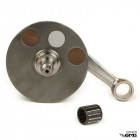


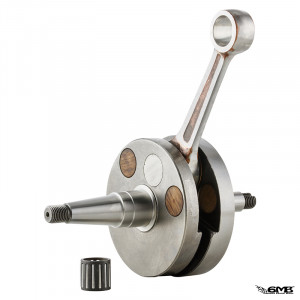
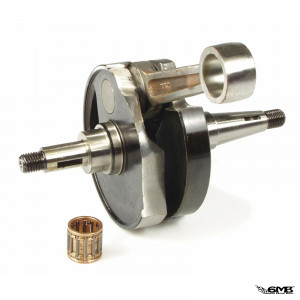
The solid cheek shafts were primarily developed to improve the pre-compression ratio and thus increase the cylinder charge above the increased pressure in the crankcase. However, the installation of the full cheek shaft greatly reduces the effective cross-section of the intake manifold. As a result, the possible degree of filling in the upper speed range decreases considerably, and engines equipped with such a crankshaft usually have a sharp drop in output at 7,000 rpm.
| Bearings | |
|---|---|
| sizes: | 16x20x20mm |
| Gudgeon pins | |
| diameter: | 16 mm |
| Crankshafts | |
| stroke: | 60 mm |
| thread rotor side: | M12x1,25 right-hand thread |
| thread drive side: | M12x1,5 right-hand thread |
| diameter crankwebs: | 98 mm |
| diameter bearing seat rotor side: | 25 mm |
| diameter bearing seat drive side: | 25 mm |
| diameter oil seal seat rotor side: | 24 mm |
| diameter oil seal seat drive side: | 31 mm |
| full circle crankshaft: | |
| filling material for full circle: | steel |
| rotary valve crankshaft: | |
| crankcase has to be milled: | |
| engine casing has to be modified: | |
| Connecting rods | |
| length connecting rod: | 105 mm |
| diameter small end connecting rod eye: | 20 mm |
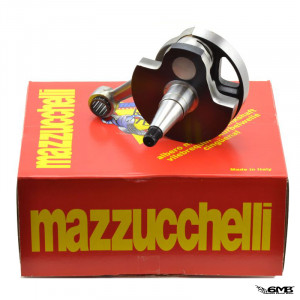
By BrandMazzucchelli



By Category
-300x300.jpg "SIP Premium Crankshaft Long Stroke PX200 by Primat...")

-300x300.jpg "SIP Performance Headlamp LED Vespa PX")
-300x300.jpg "SIP Pordoi Mirror Bar End Left/Right (1pc) Black")
-300x300.jpg "SIP Glorious Master Cylinder Vespa New PX")
-300x300.jpg "SMARTCARB 28mm SC3 lefthand flat slider")
-300x300.jpg "SIP Performance Radial DIsc Brake PX")
-300x300.jpg "SIP Pordoi Mirror Bar End Left/Right (1pc) Silver ...")
-300x300.jpg "SIP Pordoi 2.5 x 10 Inches Black Chrome")

-300x300.jpg "SIP Big Box Racing Exhaust Road 2.0 PX200")
-300x300.jpg "SIP Clutch Race-Hitech Supersport 23 for 65 primar...")
-300x300.jpg "SIP Conversion Kit Touring 2.0 12V PK for PTS")
-300x300.jpg "SIP Tubeless Rim 3.00 x 11 for 110-130 Wide Tyres ...")
-300x300.jpg "SIP Steering Head Bearing Set Premium Upper/Lower")
-300x300.jpg "SIP KIT Radial Matte Black Vespa New PX")
-300x300.jpg "SIP Road Racing Exhaust Banana Vespa PTS")
-300x300.jpg "SIP Spacer Kit For SIP Tubeless Rim 1,5mm , for 10...")